Dapeng Oliver Wu
Professor of Department of Electrical & Computer Engineering Professor of Department of Computer and Information Science and Engineering (by courtesy) Director, NSF Center for Big Learning Office:
431 Engineering Building Department
of Electrical & Computer Engineering Mailing Address: Department of Electrical
& Computer Engineering
P.O.Box 116130 Gainesville,
Florida 32611-6130 UPS/FedEx Mailing Address: 1064 Center Drive Tel: (352) 392-4954 Fax: (352) 392-0044 Email:
dpwu@ufl.edu
Homepage:
http://www.wu.ece.ufl.edu |
|
Education
- Ph. D. in Electrical & Computer
Engineering, Carnegie Mellon University,
Pittsburgh, PA, 2003
- M. E. in Electrical Engineering, Beijing
University of Posts & Telecommunications, Beijing, P. R. China, 1997
- B. E. in Electrical Engineering, Huazhong University of Science and Technology, Wuhan,
P. R. China, 1990
Here is my short biography, long curriculum vitae (in PDF), and academic family.
Research Interests
-
Network Science, Theory of Complex Systems,
Complexity Theory
- Network science is a
new and emerging scientific discipline that examines the interconnections
among diverse physical, informational, biological, cognitive, and social
networks. This field of science seeks to discover common principles,
algorithms and tools that govern network behavior.
- We would like to answer
the following questions: Can we use simple models to describe the
structures, functions, behaviors of complex biological systems? If
yes, how? Can we crack the code of biological systems or even the
universe?
- Network science is a
new and emerging scientific discipline that examines the interconnections
among diverse physical, informational, biological, cognitive, and social
networks. This field of science seeks to discover common principles,
algorithms and tools that govern network behavior.
- Deep learning
- Natural Language processing
- Knowledge Centric Networking (KCN)
- Unified approach for logical reasoning and deep learning
-
Wireless Communications
- Video Coding, Image Processing, Computer Vision,
Medical
Imaging/Bioimaging
- Explore three basic
problems: imaging, compression, image understanding/interpretation
-
Multimedia Communication over the
Internet and
over wireless
- Computer and Communication Networks, Queueing Theory
- Information Security (especially, multimedia security)
and Network Security (especially, wireless network security)
-
Information Theory
- Communication Theory
- Signal Processing, Detection and Estimation Theory
- Control Theory
- Machine Learning
-
Computational biology
- Unified theory for matter, energy, and information,
where the cyberspace meets the physical world.
- Computational complexity theory
- Logic and plausible reasoning (deductive, inductive, abductive, and transductive
reasoning)
- Smart grid and power grid (including
renewable energy)
- Anthropology

Research Group
-
Multimedia Communications and
Networking Laboratory (MCN), University of Florida (directed by Dr. Dapeng Oliver Wu)
Affiliations
- NSF Center for Big Learning
- Wireless Information Networking
Group (WING), University of Florida
-
Florida Institute for Cybersecurity
Research (FICS Research),
University of Florida
- Center for Remote Sensing, University of Florida
- Genetics Institute,
University of Florida
Research Projects
and Topics
- DeepCloud: a cloud computing platform for machine learning and deep learning
- Quantum computing
- Quantum artificial intelligence
- Artificial intelligence for medicine
- Artificial intelligence for drug design
- Artificial intelligence for epidemic outbreak prediction and containment
- Artificial intelligence for education
- Artificial intelligence for arts (music composition and training, poem writing, etc.)
- Unification of arts and science (music manifold, circle of fifth)
- Federated learning
- Autonomous vehicles
- Vision language intelligence, image captioning
- Large-scale real-time hybrid
network emulator (consisting of real nodes and virtual nodes)
- Large-scale human brain simulator
-
Large-scale power grid
and communication network co-simulator
- 5G wireless networks
- Online social networks
- Recommendation systems
- DeerNet:
wireless sensor networking for wildlife behavior analysis and interaction
modeling
- Effective capacity approach to
quality of service provisioning in wireless networks
- Computational information theory (e.g., Blahut's iterative algorithm for calculating channel
capacity and rate distortion function, proof of convergence, numerical
analysis for information theory)
- EncyclopediaNet: A Large-Scale
Hierarchical Knowledge Database, which is similar to ImageNet and WordNet.
- Uncertainty principle in information theory
- C-R-D theory (C: cost includes computational
complexity, power consumption, memory size, delay; R: rate; D: distortion)
- Computational probability theory (e.g., Neuts' matrix geometric approach, belief propagation,
proof of convergence, numerical analysis for probability theory)
- Multiscale geometric analysis: Ripplet, curvelet, ridgelet, bandelet, wedgelet, contourlet, chirplets, shearlets, noiselets, wavelet packet, and over-complete wavelet
- Distributed source coding, distributed image/video coding
- Compressed sensing, sparse approximation
- Linear/nonlinear integer transform
- Computer vision based video coding
- Next generation video coding
- Object tracking
- Change detection
- Object classification and pattern classification
- Video Streaming, IPTV, Mobile TV (p2p video streaming)
- 3D vision
- Text mining
- Biometrics, speaker
recognition
- Machine learning approach to
network security, information security, and digital forensics
- Structure, function, and dynamics of networks
(biological networks, communication networks, social networks, economic
networks, power grid, transportation network, etc.)
- Smart power grid
- Detection of economic bubbles or financial crises
- Network monitoring, network anomaly detection (machine
learning approach)
- Distributed congestion control (optimization-based flow
control vs. TCP)
- Software defined radio
- Simulator for Channel Estimation
and Adaptive Equalization in Fading Channels
- Non-stationary channel modeling and simulator design
for land/satellite/maritime mobile communication and underwater
communication
- Wireless Video
- Wireless Sensor Networks
- Video
Distortion Analysis Tool
- Bioinformatics
- Performance Analysis and Design of
Burst-frame-based CSMA/CA Protocols
- Jamming, anti-jamming
Techniques
Developed by My Group and Collaborators
- Effective capacity of a wireless
fading channel
- DyScore: fast and accurate prediction of protein-ligand binding affinity
- Ripplet transform for signal
processing, image processing, feature extraction, computer vision, machine
learning:
- RED theory for delay constrained
communication
- Evolutionary spectrum approach to
modeling non-stationary fading channels
- Geometric segmentation
for 3D vision
- Gamma rate theory for
source coding and video coding
- Self-Organizing-Queue based clustering for machine learning: technology licensing
- Social Networking Reduces Peak Power Consumption in Smart Grid: technology licensing
- A Joint Fountain Coding and Network Coding Approach to Loss-Tolerant Information Spreading: technology licensing
Openings in Multimedia
Communications and Networking Laboratory
 For new applicants who intend to
apply for the Ph.D. program in ECE department, U.F.:
For new applicants who intend to
apply for the Ph.D. program in ECE department, U.F.:
Refer to notice for graduate applicants seeking research assistantships for details.
No postdoc openings currently
Students and Visitors
- Paul Gibbons (undergraduate student)
- Herman Alexander Gonzalez (undergraduate student)
- Hong Huang (Ph.D. student)
- Haotian Jiang (Ph.D. student)
- Tianqi Liu (Ph.D. student)
- Xiyao Ma (Ph.D. student)
- Heng Qiao (Ph.D. student)
- Zhuobiao Qiao (Ph.D. student)
- Chaoyue Sun (Ph.D. student)
Alumni
- Dr. Yanlin Zhou, Employment: Samsung Research, CA, USA
- Dr. Tong Shao, Employment: Dolby, CA, USA
- Dr. Zheng Feng, Employment: postdoc, UF
- Dr. Yanjun Li, Employment: Baidu Research USA
- Dr. Qile Zhu, Employment: Amazon
- Dr. Xiaoyong Yuan, Employment: Assistant Professor, Michigan Technological University
- Dr. Rajendra Bhat, Employment: Depository Trust & Clearing Corporation (DTCC), FL, USA
- Dr. Chiranjib Sur, Employment: General Electric (GE), CA, USA
- Dr. Qi Cai, Employment: Facebook, CA, USA
- Dr. Manu Chandran, Employment: BeenaVision, GA, USA
- Dr. Jiade Li, Employment: Facebook, CA, USA
- Dr. Yun Zhu, Employment: Google, CA, USA
- Dr. Qiuyuan Huang, Employment: Microsoft Research, Redmond, WA, USA
- Dr. Kairan Sun, Employment: Facebook, CA, USA
- Dr. Xin Li, Employment: Samsung, CA, USA
- Dr. Pratik Prabhanjan Brahma, Employment: Volkswagon Electronic Research Laboratory, CA, USA
- Dr. Huazi Zhang, Postdoc, Huawei
- Dr. Ruigang Fang, Ph.D., Employment: Amazon, USA
- Dr. Shijie Li, Ph.D., Employment:
Bloomberg, USA
- Dr. Baohua Sun, Ph.D., Employment:
LSI Corporation, USA
- Dr. Yuejia He, Ph.D., Employment:
Bloomberg, USA
- Dr. Christopher Paulson, Ph.D., Employment: Air Force
Research Lab, USA
- Dr. Zheng Yuan, Ph.D.,
Employment: Real Communications, Inc., USA
- Dr. Hyung Rai Oh, Postdoc,
Employment: Samsung, South Korea
- Dr. Zongrui Ding, Ph.D.,
Employment: Intel, USA
- Dr. Yakun Hu, Ph.D., Employment:
Bloomberg, USA
- Dr. Qian Chen, Ph.D., Employment: Dolby, USA
- Dr. Lei Yang, Ph.D.,
Employment: Google, USA
- Dr. Taoran Lu, Ph.D., Employment:
Dolby, USA
- Dr. Zhifeng Chen, Ph.D., Employment: Professor, Fuzhou University, Fujian, China
- Dr. Bing Han, Ph.D.,
Employment: Qualcomm, USA
- Dr. Jun Xu, Ph.D.,
Employment: Apple, USA
- Dr. Xihua Dong, Ph.D.,
Employment: Intel, USA
- Dr. Youngho Jo, Ph.D.,
Employment: South Korea Army
- Dr. Xiaochen Li, Ph.D., Employment: Trellisware Technology, USA
- Dr. Jieyan Fan, Ph.D., Employment:
Google, USA
- Dr. Jianfeng Wang, Ph.D., Employment:
Philips Research North America, USA
- Dr. Jing Zhao, Ph.D.
- Dr. Sinisa Todorovic,
Ph.D., Employment: Professor, School of Electrical Engineering
and Computer Science, Oregon State University, USA
- Dr. Kejie Lu, Postdoc,
Employment: Professor at University of Puerto Rico, Mayagüez
- Shih-Chieh Huang (M.S.)
- Scott Arnold (B.S.) continuing graduate study at U.F.
- Ashok Ayyamani, M.S.,
Employment: Stretch Inc., USA
- Jeremy Anderson (M.S.) continuing Ph.D. study at U.F.
- Ted Belser (M.S.)
(Employment: a startup company, USA)
- Ryan Blanchard (B.S.)
- Peter Borenstein (B.S.)
- David Box (B.S.)
- Alexander Chebaro, M.S.,
Employment: Exxon Mobil Corp, USA
- Qin Chen (M.S.) (Employment: Qualcomm, USA)
- Huanghuang Li (M.S.) (Employment: Google, USA)
- Ivan Cheung (B.S.)
- Deepika Dwivedi
(M.S.) (Employment: Extreme Networks, USA)
- Travis Escoffery (B.S.)
- Donald Perry Fowlkes (B.S.)
- Eddie Goude (B.S.)
- James Greco (B.S.)
- Cancan Huang (M.S.) (Employment: ZTE Corporation, USA)
- Ashish
Jain
(M.S.) continuing Ph.D. study at Carnegie Mellon University
- Matthew Koenn
(B.S.) continuing graduate study at U.F.
- Vignesh Krishnan (M.S.) (Employment: Mathworks, USA)
- Huanghuang Li (M.S.)
- Yiran Li (M.S.) Employment:
NXP Semiconductors, USA
- Feng Liu (B.S.)
- Shuang Liu (M.S.) Employment: Apple, USA
- Emanuel Manco (B.S.)
- David Mohammed (B.S.)
- Stuart G. Nielson (M.S.) (Employment: Raytheon, USA)
- Alvaro Obregon (B.S.)
- Martin Parks (B.S.)
- Manasa Raghavan
(M.S.) (Employment: Neurotronics Inc., USA)
- Archana Rao (M.S.) (Employment:
Microsoft, USA)
- Forrest Voight (B.S.)
- Dong Wang (M.S.) (Employment: Amazon, USA)
- Jiangping Wang (M.S.)
- Wenxing Ye (M.S.) Google, USA
- Wen Ping Yeh (B.S.)
Past Visitors
- Dr. Changqiao Xu (visiting professor)
- Dr. Lujie Zhong (visiting professor)
- Jian Wu (visiting Ph.D. student)
- Dr. Gaoyun An (visiting professor)
- Dr. Zengshun Zhao (visiting professor)
- Xu Zhang (visiting Ph.D. student)
- Dr. Wei Wang (visiting professor)
- Yong Niu (visiting Ph.D. student)
- Dr. Zhengchuan Chen (visiting Ph.D.
student)
- Dr. Liquan Shen (visiting professor)
- Dr. Kwang-deok
Seo (visiting professor)
- Chenglin Li (visiting Ph.D.
student)
- Dr. Hwangjun
Song
- Dr. Lei Sun
- Dr. Tao Han
- Dr. Pengwei Hao
- Dr. Yunzhao Li
- Dr. Wang Liu
- Dr. Zhi Chen
- Yi Chen
- Dr. Qing Wang
Student Mentoring
Teaching
EEL
6825: Pattern Recognition and Intelligent Systems, Dept. of ECE, University of Florida, Spring 2022
EEL 6509: Wireless Communications, Dept. of ECE, University of Florida, Fall 2021
EEE
6512: Image Processing and Computer Vision, Dept. of ECE, University
of Florida, Fall 2021
Artificial
Intelligence: Principles and Practice, Dept. of ECE, University of
Florida, Summer 2021
EEL
6825: Pattern Recognition and Intelligent Systems, Dept. of ECE, University of Florida, Spring 2021
EEL 6509: Wireless Communications, Dept. of ECE, University of Florida, Fall 2020
EEL
6825: Pattern Recognition and Intelligent Systems, Dept. of ECE, University of Florida, Spring 2020
EEL 6509: Wireless Communications, Dept. of ECE, University of Florida, Fall 2019
EEL 6825: Pattern Recognition, Dept. of ECE, University of Florida, Spring 2019
EEL 6509: Wireless Communications, Dept. of ECE, University of Florida, Fall 2018
EEL 6825: Pattern Recognition, Dept. of ECE, University of Florida, Spring 2017
EEL 6509: Wireless Communications, Dept. of ECE, University of Florida, Spring 2017
CNT
6805: Network Science and Applications, Dept. of ECE, University of
Florida, Fall 2016
EEE
6512: Image Processing and Computer Vision, Dept. of ECE, University
of Florida, Fall 2016
EEL 6825: Pattern Recognition, Dept. of ECE, University of Florida, Spring 2016
EEL 6509: Wireless Communications, Dept. of ECE, University of Florida, Spring 2016
EEE
6512: Image Processing and Computer Vision, Dept. of ECE, University
of Florida, Fall 2015
CNT
6805: Network Science and Applications, Dept. of ECE, University of
Florida, Fall 2015
EEL 6825: Pattern Recognition, Dept. of ECE, University of Florida, Spring 2015
EEL 6509: Wireless Communications, Dept. of ECE, University of Florida, Spring 2015
EEE
6512: Image Processing and Computer Vision, Dept. of ECE, University
of Florida, Fall 2014
EEL
6935: Network Science and Applications, Dept. of ECE, University of
Florida, Fall 2014
EEL 6825: Pattern Recognition, Dept. of ECE, University of Florida, Spring 2014
EEL 6509: Wireless Communications, Dept. of ECE, University of Florida, Spring 2014
EEL
6562: Image Processing and Computer Vision, Dept. of ECE, University
of Florida, Fall 2013
EEL
6935: Network Science and Applications, Dept. of ECE, University of
Florida, Fall 2013
EEL 6825: Pattern Recognition, Dept. of ECE, University of Florida, Spring 2013
EEL 6509: Wireless Communications, Dept. of ECE, University of Florida, Spring 2013
EEL
6562: Image Processing and Computer Vision, Dept. of ECE, University
of Florida, Fall 2012
EEL
6935: Network Science and Applications, Dept. of ECE, University of
Florida, Fall 2012
EEL 6509: Wireless Communications, Dept. of ECE, University of Florida, Spring 2012
EEL
6562: Image Processing and Computer Vision, Dept. of ECE, University
of Florida, Fall 2011
EEL
6562: Image Processing and Computer Vision, Dept. of ECE, University
of Florida, Fall 2010
EEL 6509: Wireless Communications, Dept. of ECE, University of Florida, Spring 2010
EEL
4514: Communication Systems and Components,
Dept. of ECE, University of Florida, Fall 2009
EEL 4514L: Communications Laboratory, Dept. of ECE, University of Florida, Fall 2009
EEL 6509: Wireless Communications, Dept. of ECE, University of Florida, Spring 2009
EEL
6562: Image Processing and Computer Vision,
Dept. of ECE, University of Florida, Fall 2008
EEL 6509: Wireless Communications, Dept. of ECE, University of Florida, Spring 2008
EEL
6562: Image Processing and Computer Vision,
Dept. of ECE, University of Florida, Fall 2007
EEL 6509: Wireless Communications, Dept. of ECE, University of Florida, Spring 2007
EEL
6562: Image Processing and Computer Vision,
Dept. of ECE, University of Florida, Fall 2006
EEL 6509: Wireless Communications, Dept. of ECE, University of Florida, Spring 2006
EEL
6562: Image Processing and Computer Vision,
Dept. of ECE, University of Florida, Fall 2005
EEL 6509: Wireless Communications, Dept. of ECE, University of Florida, Spring 2005
EEL
6935: Multimedia Communications and Networking,
Dept. of ECE, University of Florida, Fall 2004
EEL 6509: Wireless Communications, Dept. of ECE, University of Florida, Spring 2004
EEL 6935: Special Topics in Multimedia
Communications and Networking, Dept.
of ECE, University of Florida, Fall 2003
Teaching Philosophy
Publications
List of journal publications according
to topics
List of conference publications
according to topics
Awards and Honors
Asia-Pacific Artificial Intelligence
Association (AAIA) Fellow, 2021
IEEE Distinguished
Speaker, IEEE Vehicular Technology Society, 2021
University of Florida Term Professorship
Award, 2019 - 2022
IEEE Distinguished Lecturer, IEEE
Vehicular Technology Society, 2018
University of Florida Term Professorship
Award, 2017 - 2019
IEEE Distinguished Lecturer, IEEE
Vehicular Technology Society, 2016
IEEE Fellow, Class of 2013
Best
Paper Award, IEEE GLOBECOM 2011
Best Associate Editor Award of
IEEE Transactions on Circuits and Systems for Video Technology, IEEE Circuits
and Systems Society, 2010
University of Florida Research
Foundation Professorship Award, 2009 - 2011
Outstanding Associate Editor of
IEEE Transactions on Circuits and Systems for Video Technology, IEEE Circuits
and Systems Society, 2009
AFOSR Young Investigator Program
(YIP) Award, 2009
ONR Young Investigator Program
(YIP) Award, 2008
National Research Council/AFOSR
Summer Faculty Fellowship Award, 2008
NSF Faculty Early Career
Development (CAREER) Award, 2007
National Research Council/AFOSR
Summer Faculty Fellowship Award, 2007
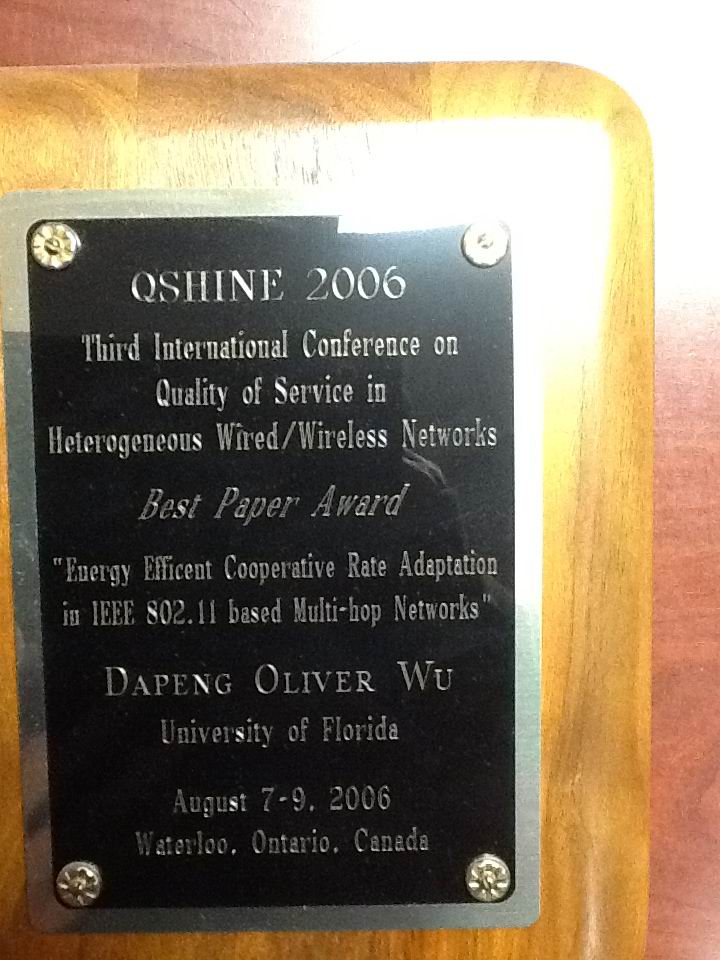
Best Paper Award,
International Conference on Quality of Service in Heterogeneous Wired/Wireless
Networks (QShine 2006)
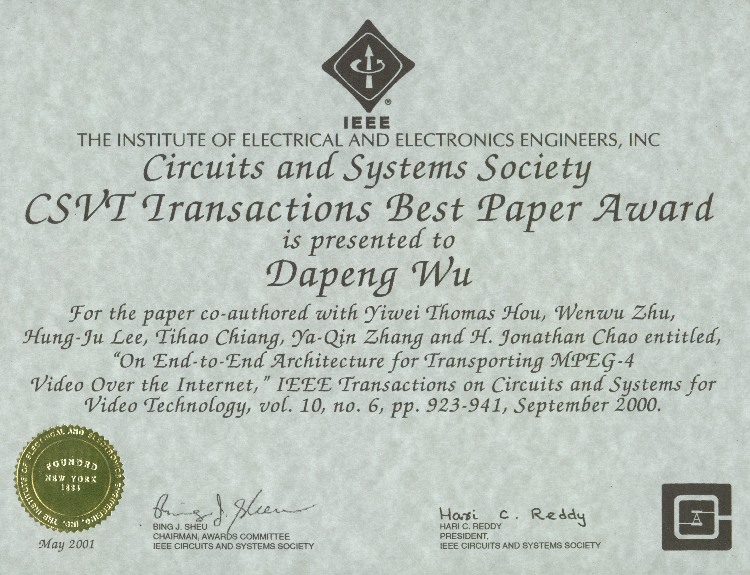
IEEE CSVT Transactions Best Paper Award
for Year 2001
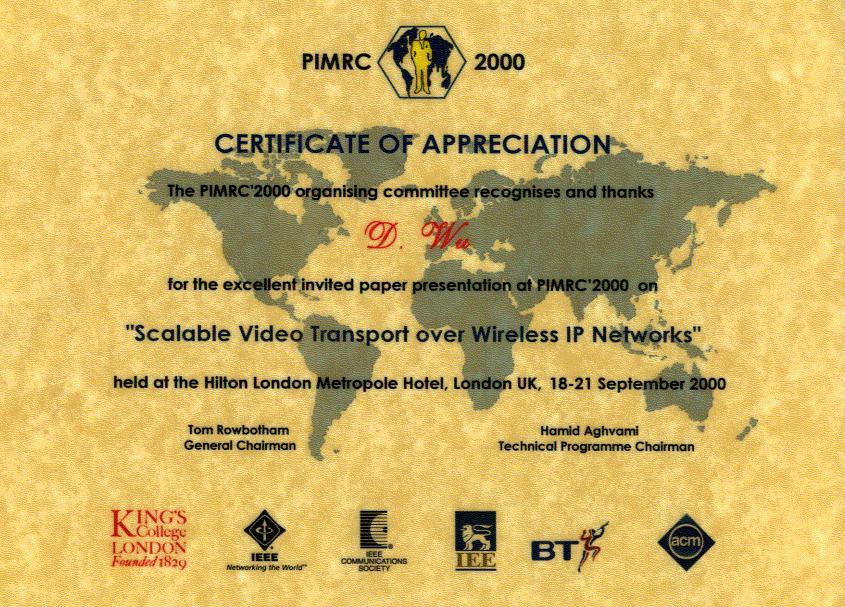
Certificate of Appreciation, IEEE
International Symposium on Personal, Indoor and Mobile Radio Communication
(PIMRC), London, UK, Sept. 18-21, 2000.
Professional
Activities
Editorship for international
journals
- Editor-in-Chief for IEEE Transactions on Network Science and Engineering, 2017--2020.
- Editor-at-Large for IEEE Open Journal of the Communications Society, 2020--present
- Founding Editor-in-Chief for Advances in Multimedia,
July 2006 – December 2008.
- Founder of
IEEE Transactions on Network Science and Engineering,
2013
- Associate Editor for IEEE Transactions on Cloud Computing, 2021--present.
- Associate Editor for Wireless Networks, Springer, November 2019--present.
- Associate Editor for IEEE Transactions on Communications, June 2016--Dec. 2018.
- Senior Editor for IEEE Signal Processing Magazine, Jan. 2015--Dec. 2017.
- Associate Editor for IEEE Transactions on Signal and Information Processing over Networks, Nov. 2014--Dec. 2017.
- Associate Editor for IEEE Transactions on Wireless Communications,
March 2006 – Nov. 2010.
- Associate Editor for IEEE Transactions on Circuits and
Systems for Video Technology, Jan. 2006 – March 2016.
- Associate Editor for IEEE Transactions on Vehicular Technology,
Jan. 2004 – Nov. 2007.
- Associate Editor for Journal of Visual Communication and
Image Representation, Elsevier, June 2010 – Dec. 2013.
- Associate Editor for International Journal of Ad Hoc and
Ubiquitous Computing, INDERSCIENCE, Sept. 2004 – Dec. 2013.
- Editor for SigPort, IEEE Signal Processing Society, April 2016--Dec. 2017
- Guest Editor for IEEE Wireless Communications, Special Issue on Emerging Visual IoT Technologies for Future Communications and Networks, 2020
- Guest Editor for IEEE Journal on Selected Areas in Communications (JSAC), Special Issue on Airborne Communication Networks, 2018
- Guest Editor for Computers & Electrical Engineering, Special Issue on Software Architecture and Modeling for Industrial Internet of Things, 2015
- Guest Editor for
IEEE Transactions on Multimedia, Special Issue on Cloud-based Video
Processing and Content Sharing, 2015
- Guest Editor for IEEE Network Magazine, Special Issue on Machine and
Robotic Networking, 2011.
- Guest Editor for Journal of Visual Communication and
Image Representation (JVCI), Special Issue on Network
Technologies for Emerging Broadband Multimedia Services, 2008. CFP link
- Guest Editor for IEEE Journal on Selected Areas in
Communications (JSAC), Special Issue on Cross-layer
Optimized Wireless Multimedia Communications, 2006.
- Guest Editor for Special Issue on HETEROGENEOUS
WIRELESS NETWORKS, ACM Mobile Networks and Applications (MONET) Journal,
2005.
Membership of steering committees
or advisory boards for international journals
- Member of the Steering Committee of IEEE Transactions on Network Science and Engineering, 2016-2017
- Member of the Steering Committee of IEEE Wireless
Communications Letters, representing the IEEE Signal Processing Society,
January 1, 2014--December 31, 2017
- Member of the Advisory Board of the EAI Endorsed
Transactions on Industrial Networks and Intelligent Systems, January
2014--present
Organizer or member of executive
committee for international conferences
- Area Chair for IEEE INFOCOM 2023, Tokyo, Japan, April 24--27, 2023.
- Track Chair for IEEE International Conference on Distributed Computing Systems (ICDCS), Track of Machine Learning on or for Distributed Systems, Bologna, Italy, July 10--13, 2022.
- Area Chair for IEEE INFOCOM 2022, London, UK, May 2--6, 2022.
- Technical Program Committee Chair for International Conference on Artificial Intelligence, Automation and Algorithm (AI2A 2021), Singapore, July 23--25, 2021.
- Area Chair for IEEE INFOCOM 2021, Vancouver, Canada, May 10--13, 2021.
- Award Chair for NeurIPS 2020 Workshop on Scalability, Privacy, and Security in Federated Learning (SpicyFL 2020), Vancouver, Canada, December 5--12, 2020.
- Technical Program Committee Chair for the 3rd International Conference on Machine Learning and Machine Intelligence (MLMI 2020), Hangzhou, China, September 18--20, 2020.
- Area Chair for IEEE INFOCOM 2020, Toronto, Canada, July 6--9, 2020.
- General Chair for IEEE International Conference on Smart Internet of Things (SmartIoT), Tianjin, China, August 9---11, 2019.
- Technical Program Committee Chair for World Transport Convention, Track for Communication, Navigation and Surveillance in Air Transportation, Beijing, China, June 13---16, 2019.
- General Chair for IEEE INFOCOM Workshop on Machine Learning for Networking, Paris, France, April 29, 2019.
- Technical Program Committee Chair for World Transport Convention, Track for Communication, Navigation and Surveillance in Air Transportation, Beijing, China, June 18---21, 2018.
- General Chair for IEEE INFOCOM Workshop on Knowledge Centric Networking (KCN), Honolulu, HI, USA, April 16, 2018.
- Conference Board Liaison for IEEE Global Conference on Signal and Information Processing (GlobalSIP), Montreal, Canada, November 14--16, 2017.
- General Chair for International Conference on Smart Internet of Things (SmartIoT), Dalian, Liaoning, China, August 18---19, 2017.
- Technical Program Committee Chair for World Transport Convention, Track for Communication, Navigation and Surveillance in Air Transportation, Beijing, China, June 4---6, 2017.
- Area Chair for IEEE VCIP 2016, Chengdu, Sichuan, P.R. China, November 27--30, 2016.
- General Chair for IEEE Global Conference on Signal and
Information Processing (GlobalSIP
2015), Orlando, FL,
USA, December 14--16, 2015.
- Technical Program Committee Chair for International Conference on Future Internet Technologies (CFI), Seoul, Korea, June 8--10, 2015.
- Area Chair for IEEE INFOCOM 2014, Toronto, Canada, April 27--May 2, 2014.
- Tutorial Chair for Visual Communications and Image
Processing (VCIP), Kuching, Sarawak, Malaysia, November 24--27, 2013.
- Panel organizer, IEEE Computer
Communications Workshop (CCW), Niagara Falls, Ontario, Canada,
November 13--15, 2013.
- Chair, NSF Workshop on Future Directions
of Wireless Networking, Arlington, VA, USA, November 4--5,
2013.
- Member of Steering Committee for International
Conference on Advances in Computing, Communications and Informatics
(ICACCI), Mysore, India, August 22--25, 2013.
- General Chair for International Symposium on Security
in Computing and Communications (SSCC), Mysore, India, August 22--24,
2013.
- Area Chair for IEEE INFOCOM 2013, Turin, Italy, April
14--19, 2013.
- Panel organizer, NSF Workshop on Big Data: From
Signal Processing to Systems Engineering, Arlington, VA, USA,
March 21--22, 2013.
- Special Session Organizer, Asia-Pacific Signal and
Information Processing Association (APSIPA) Annual Summit and Conference,
Hollywood, CA, USA, December 3--6, 2012.
- Program Co-Chair for IEEE International Conference on
Communications in China, Signal Processing for Communications Symposium,
Beijing, China, August 15--18, 2012.
- Chair for Best Paper Award Committee of IEEE INFOCOM
2012, Orlando, FL, USA, March 25 -- March 30, 2012.
- Technical Program Committee Chair for IEEE
INFOCOM 2012, Orlando, FL, USA, March 25 -- March 30, 2012.
- Poster & Demo Chair for International Conference on
Mobile and Ubiquitous Multimedia (MUM) 2011, Beijing,
China, December 7--9, 2011.
- Area Chair for IEEE International Conference on Image
Processing (ICIP), Brussels, Belgium, September 11--14, 2011.
- Publicity Chair for IEEE Workshop on Signal Processing
Advances in Wireless Communications (SPAWC 2011), San
Francisco, CA, USA, June 26 -- June 29, 2011.
- Area Chair for IEEE INFOCOM 2011, Shanghai, China,
April 10--15, 2011.
- General Chair for IEEE International Conference on
Multimedia and Expo (ICME) 2009, Workshop on Emerging Technology in
Multimedia Communication and Networking, New York City, NY, USA, June 28 –
July 3, 2009.
- Program Co-Chair for International Conference on
Communications (ICC 2008), Signal
Processing for Communications Symposium, May 19-23, 2008.
- Program Co-Chair for International Conference on Aging,
Disability, and Independence (ICADI 2008), Research
and Development Theme, St. Petersburg, Florida, USA, February 20--23,
2008.
- Track Chair, IEEE Vehicular Technology Conference (VTC 2007 Fall
conference), Wireless Applications Track, Baltimore, Maryland,
USA, October 1--3, 2007.
- Student Travel Grant Chair for IEEE
INFOCOM 2007, Anchorage, Alaska,
USA, May 6-12, 2007.
- Publicity Chair for IEEE
INFOCOM 2007, Anchorage, Alaska,
USA, May 6-12, 2007.
- Track Chair for IEEE International Conference on
Multimedia and Expo (ICME 2006), Multimedia
Networking Track, Toronto, Canada, July 9--12, 2006.
- Publicity Chair for International Wireless
Communications & Mobile Computing Conference (IWCMC 2006), Vancouver, Canada, July 3--6,
2006.
- Publicity Co-Chair for IEEE Consumer Communications and
Networking Conference (CCNC 2006), Las Vegas,
Nevada, USA, January 7--10, 2006.
- Publicity Co-Chair for First International Conference
on Collaborative Computing: Networking, Applications and Worksharing (CollaborateCom 2005), San Jose,
California, USA, December 19--21, 2005.
- Student Travel Awards Chair for First International
Conference on Security and Privacy for Emerging Areas in Communication
Networks (SecureComm 2005), Athens,
Greece, September 2005.
- Organizer of Special session on mobile and wireless
multimedia, IEEE International Conference on Communications (ICC
2005), Seoul, Korea, May 16 - 20, 2005.
- Program Co-Chair for IEEE/ACM First International
Workshop on Broadband Wireless Services and Applications (BroadWISE
2004), San José, CA, USA,
October 25, 2004.
Member of Technical Program
Committees for international conferences
- IEEE INFOCOM 2019, Paris, France, April 29 -- May 2, 2019.
- IEEE INFOCOM 2018, Honolulu, HI, USA, April 15--19, 2018.
- IEEE INFOCOM 2017, Atlanta, GA, USA, May 1--4, 2017.
- IEEE INFOCOM 2016, San Francisco, CA, USA, April 10--April 15, 2016.
- IEEE INFOCOM 2015, Hong Kong, China, April 26--April
30, 2015.
- IEEE International Conference on Image Processing
(ICIP), Paris, France, October 27--30, 2014.
- IEEE INFOCOM 2014, Toronto, Canada, April 27--May 2,
2014.
- IEEE China Summit and International Conference on
Signal and Information Processing (ChinaSIP
2013), Beijing, China, July 6--10, 2013.
- IEEE International Symposium on Circuits and Systems
(ISCAS 2013), Beijing, China, May 19--23, 2013.
- IEEE International Conference on Smart Grid
Communications, Tainan City, Taiwan, November 5--8, 2012.
- IEEE International Workshop on Multimedia Signal
Processing (MMSP), Banff, Canada, September 17--19, 2012.
- IEEE International Conference on Multimedia and Expo
(ICME), Melbourne, Australia, July 9--13, 2012.
- IEEE International Conference on Acoustics, Speech, and
Signal Processing (ICASSP), Kyoto, Japan, March 25--30, 2012.
- IEEE International Conference on Emerging Signal
Processing Applications (ESPA), Las Vegas, NV, USA, January 12--14, 2012.
- IEEE SmartGridComm, Symposium
on Architectures and Models for the Smart Grid, Brussels, Belgium, October
17--20, 2011.
- IEEE International Workshop on Multimedia Signal
Processing (MMSP), Hangzhou, China, October 17--19, 2011.
- IEEE International Conference on Image Processing
(ICIP), Brussels, Belgium, September 11--14, 2011.
- Workshop on Simplifying Complex Network for
Practitioners (SIMPLEX'11), Minneapolis, Minnesota, USA, June 24, 2011.
- IEEE International Conference on Acoustics, Speech, and
Signal Processing (ICASSP), Prague, Czech Republic, May 22--27, 2011.
- International Wireless Communications and Mobile
Computing Conference, Caen, France, June 28 -- July 2, 2010.
- IEEE INFOCOM 2010, San Diego, California, USA, March
15-19, 2010.
- IEEE International Conference on Acoustics, Speech, and
Signal Processing (ICASSP), Dallas, TX, USA, March 14 –- 19, 2010.
- IEEE Global Telecommunications Conference (Globecom 2009), Wireless Networking Symposium, Hawaii,
USA, November 30 --December 4, 2009.
- IEEE International Workshop on Multimedia Signal
Processing (MMSP 2009), Rio de Janeiro, Brazil, October 5-7, 2009.
- IEEE International Conference on Communications (ICC
2009), Wireless Networking Symposium, Dresden, Germany, June 14--18, 2009.
- IEEE INFOCOM 2009, Rio de Janeiro, Brazil, April
19--25, 2009.
- IEEE Global Telecommunications Conference (Globecom 2008), Wireless Networking Symposium, New
Orleans, LA, USA, November 30 -- December 4, 2008.
- IEEE INFOCOM 2008, Phoenix,
Arizona, USA, April 13--19, 2008.
- IEEE Global Telecommunications Conference (Globecom 2007), Wireless
Networking Symposium, Washington, D.C., USA, November 26 -- 30, 2007.
- The Fourth International Conference on Broadband
Communications, Networks, and Systems (BROADNETS 2007), Wireless
Symposium, Raleigh, North Carolina, USA, September 2007.
- IEEE Statistical Signal Processing Workshop, Madison,
Wisconsin, USA, August 26--29, 2007.
- 16th International Conference on Computer
Communications and Networks (ICCCN 2007), Emerging Technologies and
Standards Track, Turtle Bay Resort, Honolulu, Hawaii, USA, August 13--16,
2007.
- IEEE International Conference on Communications (ICC
2007), Computer and Communications Network Security Symposium,
Glasgow, Scotland, UK, June 24--28, 2007.
- IEEE INFOCOM 2007, Anchorage,
Alaska, USA, May 6--12, 2007.
- IEEE Wireless Communications and Networking Conference,
(WCNC
2007), Hong Kong, March 11--15, 2007.
- IEEE Global Telecommunications Conference (Globecom 2006), Wireless
Communications Symposium, San Francisco, CA, USA, November 27 -- December
1, 2006.
- IEEE International Conference on Mobile Ad-Hoc and
Sensor Systems (MASS 2006), Vancouver,
Canada, October 9 - 12, 2006.
- International Conference on Algorithms, Systems, and
Applications of Wireless Networks (WASA 2006), August
15--18, 2006, Xi'an, China.
- IEEE International Conference on Multimedia and Expo (ICME
2006), Toronto, Canada, July 9--12, 2006.
- IEEE International Conference on Communications (ICC
2006), General Conference, Istanbul, Turkey, June 11--15, 2006.
- IEEE International Symposium on Circuits and Systems
(ISCAS 2006), May 21--24, 2005, Kos, Greece.
- IEEE INFOCOM 2006, Barcelona, Spain, April 24-27, 2006.
- IEEE Global Telecommunications Conference (Globecom 2005), Wireless Communications Symposium, St. Louis,
MO, USA, November 28 – December 2, 2005.
- IEEE/ACM Second International Conference on Quality of
Service in Heterogeneous Wired/Wireless Networks (QShine 2005), Orlando,
Florida, USA, August 22--24, 2005.
- IEEE Workshop on Local and Metropolitan Area Networks (LANMAN'05),
Chania, Island of Crete, Greece, September 18-21, 2005.
- IEEE International Conference on Multimedia and
Expo (ICME
2005), Amsterdam, The Netherlands,
July 6-8, 2005.
- The 2005 International Conference on Parallel
Processing (ICPP-05), Georg Sverdrups House, University of Oslo, Norway, June
14-17, 2005.
- IEEE International Symposium on Circuits and Systems (ISCAS
2005), May 23-26, 2005, Kobe, Japan.
- IEEE International Conference on Communications (ICC
2005), General Conference, Seoul, Korea, May 16 - 20, 2005.
- IEEE International Conference on Communications (ICC
2005), Multimedia Communication and Home Networking Symposium,
Seoul, Korea, May 16 - 20, 2005.
- International Workshop on Standardization,
Interoperability and Deployment of Wireless Access Solutions (SID-WAS
2005), Orlando, Florida, USA, April 21, 2005.
- IEEE International Workshop on Multimedia Systems and
Networking (WMSN’05), Phoenix,
Arizona, USA, April 7-9, 2005.
- IEEE Wireless Communications and
Networking Conference, (WCNC 2005), New Orleans, LA, USA, March
13-17, 2005.
- IEEE INFOCOM 2005, Miami, Florida, USA, March 13-17, 2005.
- IEEE International Packet Video Workshop (PV2004), Irvine, CA, USA, December 13-14, 2004.
- IEEE Global Telecommunications Conference (Globecom 2004), General Conference, Dallas, Texas, USA, November
29 – December 3, 2004.
- IEEE/ACM First International Workshop on Broadband
Wireless Services and Applications (BroadWISE 2004), San José, CA, USA, October 25, 2004.
- IEEE/ACM First International Conference on Quality of
Service in Heterogeneous Wired/Wireless Networks (QShine 2004), Dallas,
Texas, USA, October 18 – 20, 2004.
- IEEE International Conference on Multimedia and Expo (ICME 2004), Taipei,
Taiwan, June 27 – 30, 2004.
- IEEE International Conference on Communications (ICC
2004), Multimedia Technologies and
Services Symposium, Paris, France, June 20 – 24, 2004.
- IEEE International Symposium on Circuits and Systems (ISCAS
2004), May 23-26, 2004, Vancouver, British Columbia, Canada.
- IEEE Workshop on Local and Metropolitan Area Networks (LANMAN'04),
Mill Valley, CA, USA, April 25--28, 2004.
- IEEE Wireless Communications and Networking Conference
(WCNC
2004), Atlanta, GA, USA, March 21 – 25, 2004.
- 2nd International Conference on Wired/Wireless Internet
Communications (WWIC 2004), Frankfurt (Oder), Germany,
February 5 – 7, 2004.
- IEEE Consumer Communications and Networking Conference (CCNC
2004), Las Vegas, Nevada, USA, January 5 – 8, 2004.
Keynote/Plenary Speech
· ``Scalable Video Transport over Wireless Networks,'' Keynote Speech, International Conference on Pattern Recognition (ICPR 2008), Workshop on Mobile Multimedia Processing, Tampa, FL, USA, December 7, 2008.
Advisor, Interest Group (IG) on
Media Streaming, Technical Committee on Multimedia Communications, IEEE
Communications Society, 2014--present
Advisor, Interest Group
(IG) on Distributed and Sensor Networks for Mobile Media Computing and
Applications, Technical Committee on Multimedia Communications, IEEE
Communications Society, 2014--present
Chair, Conference
Committee, SigPort, IEEE Signal Processing
Society, April 2016--present
Chair, Special
Committee of Area Chairs, Multimedia Signal Processing (MMSP) Technical
Committee, IEEE Signal Processing Society, Jan. 2011--Dec. 2012
Chair, Mobile and
wireless multimedia Interest Group (MobIG), Technical
Committee on Multimedia Communications, IEEE
Communications Society, July 2004 – June 2010.
Chair, Award Committee, Technical Committee on Multimedia
Communications, IEEE Communications Society,
Sept. 2008 – June 2010.
Member of the IEEE
Signal Processing Society Publications Board, January 1, 2014--December 31, 2017
Member of the IEEE
Signal Processing Society Conference Board, January 1, 2016--December 31, 2017
Member, EDICS committee
for IEEE
Transactions on Circuits and Systems for Video Technology, Nov.
2007--present.
Member, Best Paper Award Committee, Technical
Committee on Multimedia Communications, IEEE
Communications Society, July 2004 – present.
Member, Best Paper
Award Committee, IEEE International Conference on Multimedia and Expo (ICME
2006), Toronto, Canada, July 9--12, 2006.
Director of Communications, IEEE Gainesville Section, Jan.
2004 – Dec. 2005.
Member of IEEE
- Aerospace & Electronic
Systems Society (AESS)
- Circuits and Systems Society
(CAS)
- Communications Society (ComSoc)
o Member of Multimedia Signal Processing (MMSP) Technical Committee, 1/1/2009--12/31/2012
· Vehicular Technology Society
Member of ACM
Member of American Society for Engineering Education
Research Sponsors
National Science Foundation (NSF)
Air Force Office of Scientific Research (AFOSR)
Office of Naval Research (ONR)
Defense Threat Reduction Agency (DTRA)
Air Force Research Laboratory (AFRL), Wright-Patterson AFB, Dayton, Ohio
Department of Veterans Affairs
Florida Institute of Phosphate Research (FIPR)
PCS,
Inc.
Stretch,
Inc.
Cyber
Technology Research Foundation
We would like to thank the following companies for their generous donations:
Summaries
and References for Theories (including textbooks)
Memorizing a theory does not mean mastering the theory. It is essential to understand the underlying principles and the insights of the theory. When the theory looks very natural and logical to you, you are at the stage of commanding the theory. Then you do not have to forcefully memorize it at all. A good habit in learning theories is to record and summarize how you grow from intellectual infancy to intellectual maturity on each research area. Here (http://www.wu.ece.ufl.edu/books/books.html) are the summaries and references for the subjects of my interests.
Many textbooks present theories from the theorist's perspective, rather than the user's perspective. The reader is presented with various theories, and applications of the theories based on a methodological taxonomy. A danger with this approach of presentation is that the thinking behind the theories will not be grasped, leading to misuse of the theories. Such presentation typically does not provide answers to "why does it work?", "under what condition does it work?", "Compared with other approaches, what are the pros and cons of this approach?" In textbooks divided on methodological grounds, the opportunity for comparing alternative methodologies is diminished, lessening the guidance in method selection. In some sense, the textbooks teach the reader the dead knowledge but leave the job of method selection (the thinking) to the reader. The reader needs to spend years on understanding the trade-off among various methods, and the conditions, under which a method is more suitable.
A textbook typically follows the deductive reasoning rather than inductive/plausible reasoning. Such a textbook starts with a rigorous formulation of a problem, then presents the theories to solve the problem. It seldom provides the insight and the information about how the theorist came up with the theory; it rarely discusses about the underlying principle/design philosophy; and it seldom tries to make the theory natural and logical to the reader (e.g., pointing out its similarity to other familiar things, simplifying the presentation, stressing the key point).
If a textbook is to be presented from the user's perspective, I suggest the following five steps.
- Exploring the problem and solution spaces. The
textbook should start with plausible reasoning, provide the information
about how the theorist attacked the problem (e.g., try-and-errors
examples, no-brainer/naive approaches, run-of-a-mill/classical approach,
advanced approach), discuss which one works, which one does not work, and
why it works or does not work; after some try and errors, the theorist hit
upon an idea due to some magical reason.
- Developing the theory. The book should address how the magical
idea was developed into the full-blown theory, how the theorist
systematically studied the problem using the new theory (recording all the
thoughts instead of only final version of the theory), and how to make the
theory rigorous. At this stage, the specific problem has been
abstracted to a general problem.
- Presenting the theory (in depth). The
book should present the theory using a deductive reasoning/framework,
i.e., formulate the general problem, present the theory (final version) as
a solution, provide rigorous
proofs.
- Discussing related theories (in breadth). The
book should summarize related theories in a concise and clear manner,
address the pros and cons in solving the problem, compare all the theories
in all possible aspects, and discuss the applications of the theories,
significance of the problem and the theories. (People learn
things by comparison.)
- Organize the knowledge around important principles,
concepts, and ideas.
Make connections between the new knowledge and the familiar things.
Help the student develop conditionalized
knowledge, which includes a specification of the contexts where the
theory is applicable, and the condition-action pairs required for problem
solving. In other words, help students learn how to organize
the knowledge and how to recognize the patterns of problems and solve them
effectively. In contrast, most textbooks are much more
explicit in enumerating the laws of math or of nature than in saying
anything about when these laws are applicable in solving
problems.
The five steps are natural and logical to the reader, and hence is easily accessible to the reader! The steps are first from the specific to the general (induction), making it rigorous, and then from the general to the specific (deduction).
Typically, a textbook only presents final version of the theories, which is not natural and logical to a beginner. So it is the reader's job to make the theories logical to himself/herself. This may be achieved by independent, critical, and creative thinking. Independent thinking means that the reader should have his/her own views (e.g., trying to solve the problem by his/her own approach and comparing his/her own approach with the theory). This is the first cut. Critical thinking means that the reader should relentlessly attack the theory from all possible angles. Attack its limitations and weaknesses or even tend to disprove the theory. Unless the theory is completely justified, do not accept the theory. After identifying the weaknesses of the theory, the reader is ready to think creatively. Creative thinking means that the reader makes efforts to produce something which is not in the book (e.g., insights, simpler proofs, new theorems). For example, the theory may only provide the necessary condition but the reader can provide a sufficient condition. In sum, most readers have comparable intelligence but the results of the reading (i.e., understanding of the theory and capability of applying the theory) may be quite different. The difference may be caused by the degree of curiosity, imagination, and efforts made on independent, critical, and creative thinking.
Leisure
Useful Links
Advice
on Creative Thinking, Research, Writing, Speaking
Impact Factors of
Scientific Journals,
Journal Citation Report by ISI and
Journal
Ranking in EE by ISI
The
Web's most comprehensive list of U.S. federal funding sources for scientific
research
Wireless
Technology Companies and Institutions
Lifespan of Electronic Products
The Not So Short Introduction to LaTeX 2e
Oxford Advanced
American Dictionary for Learners of English
English Dictionary with Voice
Pronunciation
Wikipedia, the free
encyclopedia or use google to find the definition of a word (define: the
word)
Online Reference Dictionary, Thesaurus,
Encyclopedia & more (http://encarta.msn.com/encnet/features/dictionary/DictionaryHome.aspx?lextype=2)
Millennium Prize Problems (Want
to try to win $1,000,000 by solving one of the seven millennium prize problems?)
International Mathematical Olympiad
Free
online courses
-
Stanford Engineering Everywhere http://see.stanford.edu/default.aspx
-
Open Yale Courses http://oyc.yale.edu/
-
Massachusetts Institute of Technology http://ocw.mit.edu/OcwWeb/web/home/home/index.htm
-
Open University http://openlearn.open.ac.uk/
-
Carnegie Mellon University http://www.cmu.edu/oli/
-
Tufts University http://ocw.tufts.edu/
-
Stanford University http://itunes.stanford.edu/
-
University of California, Berkley http://webcast.berkeley.edu/courses.php
-
Utah State University http://ocw.usu.edu/
-
Kutztown University of Pennsylvania http://www.kutztownsbdc.org/course_listing.asp
-
University of Southern Queensland http://ocw.usq.edu.au/
-
University of California, Irvine http://ocw.uci.edu/
Mottos:
- Be open-minded. Always challenge oneself with intellectually stimulating problems.
- Pursuing Ph.D. is to push forward the frontier of knowledge and develop new ways of thinking. For an undergraduate, finishing programming/simulations, collecting data, and plotting performance figures are the end of the task. But for a Ph.D., these are not the end. The final result should be original contributions that are somewhat surprising to the community of science and technology.
- A Ph.D. in Engineering is expected to apply fundamental approaches to solving practical problems. It could be application of new approaches to new/old problems. It could be application of old approaches to new problems. To achieve this, mastering the related theories is critical.
- Memorizing a theory does not mean mastering the theory. It is essential to thoroughly understand the underlying principles, the way of thinking and the insights of the theory. When the theory looks very natural and logical to you, you are at the stage of commanding the theory. Then you do not have to forcefully memorize it at all.
- The cornerstone of Ph.D. education is cultivation of independent, critical, and creative thinking.
- The key to success is keeping yourself motivated. In my view, long-distance running is an effective way to stay motivated and improve mental toughness.
- Passion and enthusiasm are the best way for success.
- Insatiable curiosity is a driving force for doing excellent research.
- Put teaching, learning, and understanding ahead of any thought of impressing colleagues with the esoteric or the obscure.
- A good research paper consists of clean problem formulations, clean notations, and clean solutions.
- Many practical problems do not have closed-form solution. So people resort to numerical algorithms or simulations to get solutions. What distinguishes a good researcher from the rest is not on nice numerical or simulation results, but on how to analyze (mathematically justify) the results and provide sound physical interpretation/insight/intuition.
- The hard part of doing research is to be a leader rather than a follower.
- Give a man a fish, you feed him for a day. Teach him to fish and he'll take care of himself.
- To some, academia is all about the disinterested pursuit of truth; another view is that academia is all about politics. People with mature outlooks fall into the realistic middle between these extremes.
- An important goal of education is to help students develop the learning strategies needed to acquire new knowledge and skills.
- Life is good. Life will become good if it is not good now. Do what you like. Like what you do.
- Jogging is a life style. It can improve your health, de-stress your busy life, release your frustration/anxiety/animosity/fear of uncertainty, and make you more efficient/optimistic. Jogging may be the best medicine for many of your problems in your everyday life.
- A way to develop creativity: When you read a book, try to write another book (which may be as short as one page); the new book may include your new interpretation about the problem, new angle to look at the problem, new methods to solve the problem, even new theory to address the problem.
- In system modeling, a model should be accurate enough to be useful and should be simple enough to be implementable.
- A difficult problem is like your opponent in the battlefield: the more frightened you are, the stronger your opponent becomes (the more difficult the problem becomes).
- Mental toughness is essential to success.
- Never too old to dream.
- Work like you don’t need the money. Love like you’ve never been hurt. Sing like no one is listening. Dance like no one is watching. Live every day as if it were your last.
- To some, a tenured faculty position is the best job in the world because 1) you have job security, 2) you can work on any topic of your choice, 3) you always work with young people (i.e., students), which makes you feel young, 4) you have a flexible work schedule, 5) you can work with or consult many talented people on and off campus, from whom you can learn a lot, 6) you enjoy a high degree of freedom, 7) you receive decent salary, 8) your high quality work helps you achieve satisfaction and recognition from the community and society.
- To some, working is due to a desire rather than a need to make a living.
- Why do painful things stay much longer in the memory of a person than happy things? This is because human memory is like discharge of charge in a capacitor with very large time constant for painful things and very small time constant for happy things. So a method to keep happiness is to frequently refresh the memory by the past happy things, e.g., seeing photos; a way to keep away from unhappiness is to make oneself tired, e.g., running long distance.
- “Concentration" and "faith in one's self" are essential requisites in every avenue of human endeavor.
Quotations:
The Master in the art of living makes little distinction between his work and his play, his labor and his leisure, his mind and his body, his education and his recreation, his love and his religion. He hardly knows which is which. He simply pursues his vision of excellence in whatever he does, leaving others to decide whether he is working or playing. To him he is always doing both.
Zen Philosophy
The mathematician’s patterns, like the painter’s or the poet’s, must be beautiful; the ideas, like the colours or the words, must fit together in a harmonious way. Beauty is the first test: there is no permanent place in the world for ugly mathematics.
An intelligent problem-solver tries first of all to understand the problem as fully and as clearly as he can. Yet understanding alone is not enough; he must concentrate upon the problem, he must desire earnestly to obtain its solution. If he cannot summon up real desire for solving the problem, he would do better to leave it alone. The open secret of real success is to throw your whole personality into your problem.
Intellectual courage, intellectual honest, and wise restraint are the moral qualities of the scientist. (Intellectual courage = dare to challenge authority; intellectual honest = dare to admit that yourself made a mistake if you did; wise restraint = do not follow others without some good reason)
By endurance, we conquer.
We may have knowledge of the past and cannot control it; we may control the future but have no knowledge of it.
There will be plenty of time to rest in the grave.
Private property is a nuisance.
Nothing is more important than to see the sources of invention which are, in my opinion, more interesting than the inventions themselves.
Luck favors the prepared mind.
Genius is 1% inspiration and 99% perspiration.
If I have seen further than others, it is because I have stood on the shoulders of giants.
I was like a boy playing on the sea-shore, and diverting myself now and then finding a smoother pebble or a prettier shell than ordinary, whilst the great ocean of truth lay all undiscovered before me.
If we knew what it was we were doing, it would not be called research, would it?